Commercial Waste Bracknell: Recycling and Sustainability Strategy
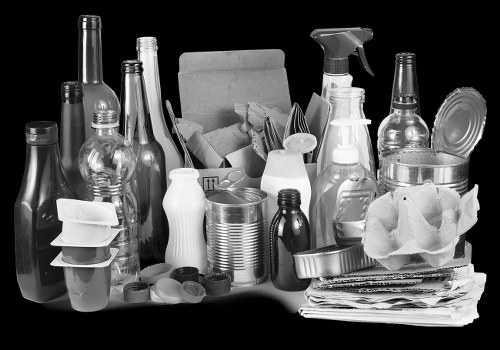 Commercial Waste Bracknell is committed to creating an eco-friendly waste disposal area that supports local businesses, reduces carbon emissions and increases reuse and recycling rates across the borough. This page outlines the sustainability approach for managing commercial waste in Bracknell, highlighting our recycling percentage target, partnerships with charities, local transfer stations and low-carbon fleet investments. Our aim is to make Bracknell commercial recycling both practical and measurable for organisations of all sizes.
Our plan sets a clear recycling percentage target: we are aiming for a 65% recycling and diversion rate for commercial waste by 2030. This target aligns with regional sustainability goals and reflects the borough’s move toward more circular practices. To hit this benchmark we emphasise source separation, improved collections, and stronger partnerships with reprocessors and reuse networks. Businesses are encouraged to adopt simple segregation at source systems so that mixed streams are minimised and valuable materials are recovered.
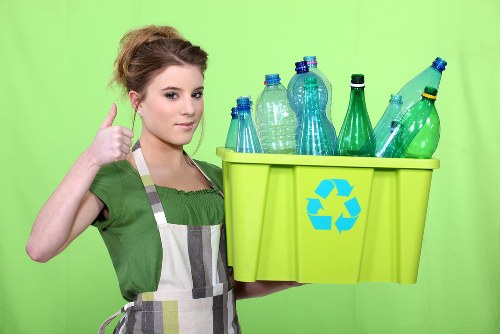 To make recycling easy for businesses, our commercial services include a suite of separation options and practical resources. Typical materials we manage through dedicated collections include:
- Paper and cardboard – high-quality streams for local mills
- Glass bottles and jars – separated by colour where possible
- Food and organic waste – composting and anaerobic digestion
- WEEE and electricals – secure handling for reuse or material recovery
- Mixed dry recyclables – sorted at transfer stations to improve yields
Local Infrastructure and Transfer Stations
Bracknell’s network of local transfer stations plays a pivotal role in achieving the borough’s sustainable rubbish area ambitions. Transfer stations act as consolidation hubs where collected commercial waste is sorted, baled and sent to specialist processors. By shortening collection routes and increasing on-site sorting, these facilities help reduce double-handling and fuel use. Our partnerships with nearby facilities ensure that glass, cardboard, organics and bulky recyclables are routed to the correct local or regional reprocessors.
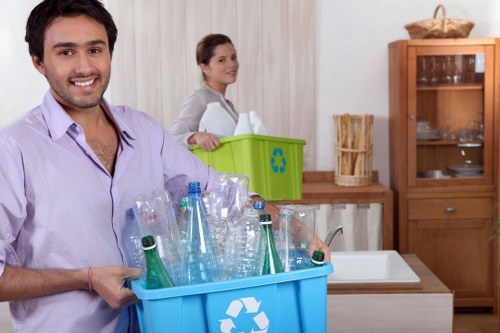 The borough’s approach to waste separation encourages businesses to use labelled containers for different streams — a method that mirrors household kerbside schemes but scaled for commercial needs. Many commercial units follow the same five-stream model as the borough: paper/cardboard, mixed recycling, glass, food/organic, and residual waste. This consistency enables easier processing at transfer stations and higher recovery rates across the supply chain.
To support practical implementation, we work with local logistics providers to map collection schedules around business hours and minimise disruption. Efficient route planning and consolidation at transfer points underpin the goal of a low-carbon, efficient collection system.
Partnerships, Reuse and Low-Carbon Collections
We believe that sustainable commercial waste management extends beyond collection: reuse and charity partnerships are central to reducing landfill and supporting the local community. Through collaborations with charities and social enterprises, usable furniture, appliances and surplus stock from businesses are diverted for reuse. These partnerships not only reduce waste but also provide social value—supporting training, employment and local redistribution initiatives.
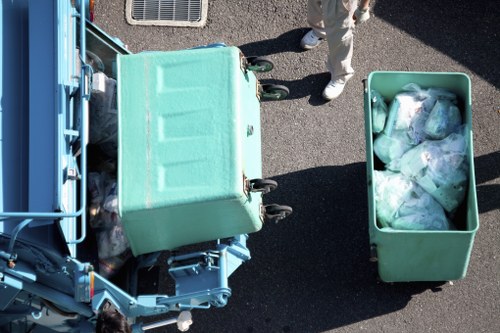 Our fleet strategy includes investment in low-carbon vans and electric-powered collection vehicles to serve the eco-friendly waste disposal area mandate. These low-emission vehicles are deployed on dense urban routes and to business parks where stop-start driving traditionally increases fuel consumption. Switching to low-carbon vans reduces overall fleet emissions and complements wider measures such as consolidated drop-offs at transfer stations.
 Measuring progress is essential. We publish regular metrics on diversion rates, carbon reductions and reuse volumes so businesses can see the positive impact of their segregation and recycling efforts. Data-driven route optimisation, combined with training for staff on correct segregation practices, will be central to consistently meeting or exceeding our recycling percentage target.
Operationally, we encourage businesses to adopt simple policies: segregate at source, compact where appropriate, and keep contamination low. This helps recycling streams remain high-quality and marketable. In addition, we facilitate periodic audits and provide educational materials that mirror the boroughs approach to waste separation, ensuring alignment between commercial and residential systems.
Key stakeholders in the commercial waste ecosystem include local authorities, transfer station operators, reuse charities, and private recycling firms. Working together, these groups enable a practical pathway to a sustainable rubbish area where material loops are closed and landfill is reduced. We use evidence-led decisions to prioritise investments that accelerate recycling and reduce carbon footprints for businesses across Bracknell.
By combining targeted recycling goals, strategic use of transfer stations, active charity partnerships and a low-carbon collection fleet, Commercial Waste Bracknell is building a resilient, efficient and community-focused approach to commercial waste. Together, we can transform commercial waste in Bracknell into a resource for local industry, reuse networks and low-carbon energy recovery—supporting a greener future for the borough.
